How to Start a Business in the UK as a Foreigner: 2026 Guide

Starting a business in the UK is quick, and you can register a company in a day. The harder part comes after, when you deal with visas, tax rules, banking, and compliance as a foreign founder.
This guide explains how to start a business in the UK in 2026 with clear steps, costs, and requirements so you can set up your company properly and avoid unexpected delays.
Key Takeaways
- With around 5.7 million private businesses in 2025, the UK is built for entrepreneurship, and foreign founders contribute to a huge part of that growth.
- You can own a UK company from anywhere in the world, but working in the UK requires a visa that permits business activity.
- Choosing the right structure (Sole Trader, Partnership, LTD, or LLP) affects tax, liability, credibility, and how quickly you can scale.
- Managing payments early is essential for smooth operations, and DSGPay can help foreign founders handle GBP and international transactions.
Step-by-Step Process to Start a Business in the UK
Starting a business in the UK follows a predictable structure, but the details matter, especially for foreign founders who must meet both business and immigration requirements. These steps outline exactly what you need to do, why each step exists, and what to prepare before you begin.
Step 1 – Validate Your Idea and Understand the UK Market
Before filing anything with Companies House, make sure your business actually meets a real need in the UK.
- Test your idea with surveys, interviews, early demos, or prototypes.
- Check what competitors charge and how they position themselves.
- Identify who your buyers are and what they value.
- Use negative feedback to refine your product or service.
- Confirm demand, pricing, and differentiation.
Thorough research also helps you choose the right structure and forecast costs more accurately.
Step 2 – Confirm Your Eligibility to Operate a UK Business
Make sure your immigration and legal status permit you to run or manage a business in the UK.
Key points to remember are:
- You are allowed to own and register a UK company even if you live overseas.
- All companies, whether run locally or remotely, must follow UK corporate rules and reporting requirements.
- If you plan to work in the UK, manage operations on-site, or meet clients in person, you must hold a visa that permits business activity.
- Business-friendly visa options include the Innovator Founder Visa, Global Talent Visa, Skilled Worker Visa through the self-sponsorship model, and the UK Expansion Worker Visa.
This step is simply about confirming your legal footing so you can proceed with company formation safely and correctly.
Step 3 – Choose the Business Structure That Fits Your Model
At this stage, you need to select which structure your business will operate under.
The main structures you can choose from include:
- Sole Trader: You run the business as an individual and take full personal responsibility for debts and obligations. This is the simplest option and works for freelancers, contractors, or anyone testing an early idea.
- Partnership: Two or more people share ownership, responsibilities, profits, and financial risk. This model suits small teams who want a straightforward shared setup without creating a separate legal entity.
- Limited Company (LTD): A legally separate entity where the company carries the financial risk, not the owners. Directors manage the company, shareholders have limited liability, and the structure supports credibility, scalability, and long-term growth.
- Limited Liability Partnership (LLP): A flexible partnership model that protects members’ personal assets while allowing them to decide how profits are allocated. It is commonly used by consulting, accounting, and legal firms.
💡Tip:
How to decide
- Choose an LTD when planning to grow, hire or attract investment.
- Choose Sole Trader when running a solo service or testing a simple idea.
- Choose Partnership when working with co-founders in a shared arrangement.
- Choose LLP when a professional team wants partnership flexibility with liability protection.
Step 4 – Check Whether Your Industry Needs a Licence
Some sectors require approval before trading.
These include:
- Food service and hospitality
- Finance and regulated activities
- Childcare
- Transport
- Beauty and cosmetic services
- Entertainment and events
Licences come from local authorities or regulatory bodies. Knowing this early helps you plan timelines and compliance.
Step 5 – Choose a Company Name and Secure a UK Registered Office
Your company name must follow UK rules and be suitable for public use. Once the name is confirmed, you also need a UK-registered office address, which is required for all companies and appears on the public record.
Your company name must:
- Be unique and not identical to an existing company.
- Avoid restricted or sensitive words.
- Be appropriate and easy to read.
- End with “Limited” or “Ltd” for a private limited company.
- Be checked for availability on Companies House.
Your registered office address must:
- Be a physical address in the UK (no P.O. Boxes).
- Be located in the same UK nation where the company is registered.
- Receive official mail from HMRC and Companies House.
Many foreign founders use professional providers such as First Formations, Rapid Formations, 1st Formations, GoSolo, or 1Office, which offer registered office services and mail forwarding.
Step 6 – Prepare Your Registration Documents
The specific documents depend on your chosen structure.
1. For Limited Companies (LTD):
Prepare the following details and documents:
- Director information
- Shareholder or guarantor details
- Share structure
- UK registered office address
- Signed Memorandum of Association
- Articles of Association (model or customised)
- Identification of People with Significant Control (PSC), usually anyone owning more than 25% of shares or voting rights
If you are registering an overseas company as a UK branch:
You must file additional documentation with Companies House:
- Form OS IN01 and the applicable fee
- Certified copies of your home country’s incorporation documents
- Certified copies of your company’s constitution
- English translations if the originals are not in English
- Details and UK addresses of any appointed UK representatives
2. For LLPs:
Prepare:
- Details of at least two members (individuals or companies)
- Proof of identity for all members and beneficial owners (certified passport or national ID)
- Proof of address for all members (recent utility bill, bank statement, or tenancy document)
- A unique LLP name that is available on the Companies House register
- Registered UK office address (physical address, no P.O. Box)
- LLP Agreement outlining roles, responsibilities, and profit sharing
- Companies House registration details, including the required form and member information
- SIC code describing your business activity
3. For Sole Traders or Ordinary Partnerships:
- Basic personal details and your chosen trading name
- Proof of identity (passport or BRP)
- Proof of UK address (recent utility bill, bank statement, or tenancy document)
- National Insurance Number (required for tax purposes)
- Registration for Self Assessment with HMRC
- Evidence of business activity, such as invoices or bank details
- A partnership agreement if two or more people are involved
Step 7 – Register Your Business with Companies House or HMRC
Registration depends on your structure:
1. Sole Traders / Standard Partnerships:
- Register directly with HMRC for Self Assessment
2. LTD or LLP:
- Register online through Companies House
- Provide documents and officer details
- Pay the registration fee
- Receive a Certificate of Incorporation
3. Foreign Companies Opening a UK Branch:
- Register a UK establishment and submit translated corporate documents
- This process takes longer than forming an LTD
Step 8 – Register for UK Taxes
Once your business is formed, you must register for the relevant tax systems.
- Limited companies must register for Corporation Tax within 3 months.
- Corporation Tax applies only to profits generated in the UK.
- Sole traders and partnerships must register for Self Assessment to pay Income Tax and National Insurance on UK-sourced income.
- VAT registration is required once annual turnover exceeds £90,000 (voluntary registration is also allowed).
- Employers must set up PAYE to deduct Income Tax and employer National Insurance for staff.
- Double Taxation Treaties may reduce or prevent being taxed twice, so many founders seek specialist tax advice to stay compliant.
Foreign founders follow the same tax rules as UK residents, but non-residents are generally taxed only on UK income.
Step 9 – Open a Business Account
Foreign founders can open a UK business account, but the process is often more detailed for non-residents. Requirements vary across providers, so it helps to understand your options before applying.
Business Account Options for Foreign Founders in the UK
Having a dependable account or payment solution in place is essential for bookkeeping, tax compliance, and day-to-day operations in the UK.
Costs of Starting a Business in the UK (2026 Overview)
Starting a business in the UK is affordable at the registration stage, but total costs vary widely depending on visas, professional support, and the type of business you plan to run.
Visa Options for Foreign Entrepreneurs in the UK
If you plan to take an active role in your UK business, you must understand which visa routes allow you to legally work, manage operations, or live in the country.
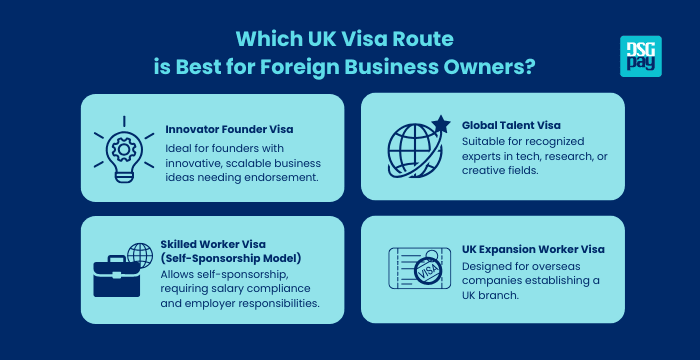
- Innovator Founder Visa: This route is built for founders who are creating something original and high-growth. You need a business idea that is innovative, scalable, and commercially strong. An endorsing body must approve your plan and check in on your progress. If accepted, you receive permission to stay for up to three years with the option to extend or settle.
- Global Talent Visa: Best for people whose expertise speaks for itself. If you are recognised in tech, research, the digital sector, or the creative fields, you can qualify based on your achievements rather than a business plan. This visa supports self-employment, consulting, and entrepreneurship and offers one of the fastest paths to settlement.
- Skilled Worker Visa (Self-Sponsorship Model): This option allows your own UK company to become a licensed sponsor and employ you in a genuine, paid role. It requires meeting salary rules, proving the role is legitimate, and taking on ongoing employer responsibilities. For many founders, it is a straightforward path to live and work in the UK.
- UK Expansion Worker Visa: Designed for overseas companies setting up their first UK branch. It allows a senior team member to enter the UK and establish operations. Once the branch is active, the business can explore additional visa routes for future growth.
Timeline: How Long It Takes to Become Operational
Here’s a quick breakdown of how long each stage typically takes, so you know what to expect as you move from setup to full operation.
Challenges and Opportunities for Foreign-Owned UK Businesses
Let’s take a look at the realities foreign founders face in the UK, the hurdles that require planning and the opportunities that can accelerate growth.
Challenges:
- Cash flow is tight for many foreign founders because of rising costs, slow bank onboarding, cross-border transfer delays, currency fees, and long B2B payment cycles. Careful financial planning is essential in the first year.
- Competition is strong, with mature industries and customers who expect fast service, transparency, and high value. Clear differentiation matters.
- Regulations can be complex, affecting data protection, employment, licensing, import/export rules, and financial reporting. Many foreign-owned companies underestimate the admin required in both the UK and their home country.
Opportunities:
- Tech, AI, and digital services are expanding quickly. There is strong demand for SaaS tools, automation, analytics, AI consulting, and cybersecurity, supported by government innovation programs.
- Construction and infrastructure continue to grow, especially in housing, regeneration, and sustainable projects. Companies offering engineering, design, or skilled labour can do well.
- Professional services such as accounting, marketing, IT support, HR, and compliance are widely outsourced. Experts with niche skills can build profitable remote-first businesses.
- The UK has a supportive innovation environment with access to global talent, an English-speaking business market, and closeness to the EU, making it ideal for scaling.
Conclusion: Navigating the UK Market as a Foreign Entrepreneur
Starting a business in the UK is manageable once you understand the requirements and prepare the right documents, licences, and financial setup.
Clear planning around visas, tax obligations, and payment systems helps foreign founders establish a solid foundation and operate with confidence.
With the right structure and preparation, the UK remains a strong and accessible market for international entrepreneurs in 2026.
Manage Your Business Payments with DSGPay
Managing payments efficiently is essential for businesses operating across borders or working with international clients and suppliers.
DSGPay supports businesses by offering payment tools that help simplify day-to-day financial operations.
Why Choose DSGPay:
- Global & Local Named Accounts: Send and receive payments under your business name.
- 30+ Supported Currencies: Hold, send, and receive major global currencies.
- Flexible Virtual Account Options: Choose account types that match your invoicing and workflows.
- Competitive FX Rates: Convert currencies with transparent pricing.
- API & Dashboard Access: Track and automate payments in real time.
- Secure, Licensed Infrastructure: Operates under a Hong Kong MSO licence with trusted partners.
Ready to simplify your business payments? Open your DSGPay business account today and start operating globally with confidence.