How to Open a Euro Account and Start Receiving EURO Payments Globally
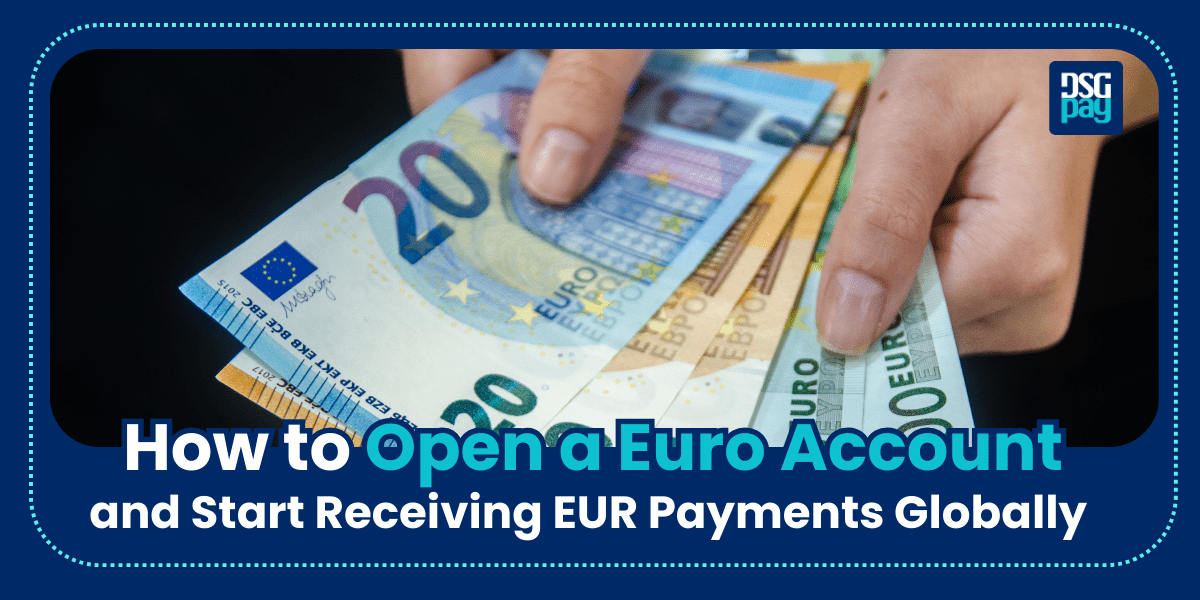
Getting paid in euros shouldn’t be complicated. Whether you run an online store, a growing SME, or a global business, European clients expect to pay in their own currency.
The solution is simple: open a Euro account. It lets you collect payments directly in euros, improve cash flow, and make your business easier to work with.
In this article, we will break down exactly how to open a Euro account and start receiving EUR payments worldwide without unnecessary friction.
Key Takeaways
- Opening a Euro account helps you to reduce FX costs, improve cash flow, and make your business easier to pay for European clients.
- Traditional banks like HSBC and Barclays offer stability but require more paperwork and longer onboarding.
- Fintechs such as Wise, Revolut, Payoneer, and Airwallex provide faster, digital-first setups with lower fees.
- Businesses need standard KYC/KYB documents: ID, proof of address, company registration, and proof of activity.
- A Euro account enables faster SEPA transfers, easier supplier payments, and smooth integration with marketplaces like Amazon EU and Shopify.
How to Open a Euro Account
The following steps outline the process to open a Euro account and begin managing payments efficiently.
Step 1: Choose the Right Type of Euro Account
Not every Euro account serves the same purpose. The right choice depends on your business model and how quickly you want to expand.
Euro Accounts via Fintech Platforms
For SMEs looking to expand quickly, fintech platforms are often the fastest way to open a Euro Account. There are no branch visits, residency requirements, or long delays. You apply online, upload your documents, and in a matter of days, you are issued a local Euro IBAN.
With providers like Wise, Revolut Business, Payoneer, and Airwallex, European clients can pay you in euros as if your company were based locally.
To help you choose the right platform, here’s how the top fintech Euro account providers compare:
| Provider | Pros | Cons |
| Wise | • Quick online signup • Real exchange rates • SEPA enabled | • No access to credit or loans |
| Revolut Business | • Multi-currency support • Modern dashboard • Competitive FX | • Account limits vary by region • Premium features may require fees |
| Payoneer | • Strong with marketplaces • Easy global integration • Popular for cross-border payouts | • Withdrawal fees apply • Limited credit options |
| Airwallex | • Local Euro IBANs • Good for SMBs and e-commerce • Competitive FX rates | • Less brand recognition with clients compared to major banks |
Euro Accounts via Traditional Banks
Traditional bank accounts from providers like HSBC, Barclays, BNP Paribas, and Deutsche Bank give your business stability, credibility, and access to a full range of financial services.
If you already operate in Europe, or plan to establish a local presence, opening a Euro account with a traditional bank can strengthen your position and provide the long-term support larger businesses often need.
To help you compare, here is a quick look at what some of the leading banks offer when it comes to Euro accounts:
| Provider | Pros | Cons |
| HSBC | • Multi-currency support • Strong global network • Access to trade finance | • May require EU residency or local entity • Higher fees • Some services are limited to business clients |
| Barclays | • Euro and USD accounts • Mobile banking tools • Strong UK/EU presence | • Extra accounts for multiple currencies • Higher transfer fees • Longer onboarding |
| BNP Paribas | • Strong EU presence • Wide corporate banking services • Trade finance support | • In-person verification • Less accessible for non-EU clients |
| Deutsche Bank | • Recognised corporate expertise • Large European network • Stable long-term partner | • Limited access for SMEs • Extensive documentation requirements • Higher entry thresholds |
Step 2: Gather Your Documents for Opening a Euro Account
Every Euro account requires KYC checks, and for businesses, KYB checks. Fintechs keep this digital and fast, while banks often add more paperwork and sometimes in-person steps.
For Fintech Platforms:
Opening a Euro account with fintechs is fast and fully digital. Most accounts can be verified within 1–2 days if your documents are ready.
What you’ll usually need:
- Government-issued ID (passport, driver’s licence, or national ID).
- Proof of address (utility bill, bank statement, or rental contract issued in the last 3 months).
- A quick selfie or liveness check for ID verification.
For Business Accounts:
- Company registration documents (certificate of incorporation, tax ID)
- IDs for directors or shareholders with 25%+ ownership
- Proof of activity, such as a website, invoice, or client contract
Practical Note: Requirements vary by country and account type, so always check the provider’s official site before applying.
For Traditional Banks:
Opening a Euro account is more formal than with fintechs. The process often requires extra paperwork and sometimes an in-person visit, especially for non-residents.
What you’ll usually need:
- Government-issued ID (passport or national ID).
- Proof of address (utility bill, rental contract, or bank statement, often a local EU address for non-residents).
- Tax identification number (TIN).
- Proof of income or employment for personal accounts.
- Business registration documents for companies.
For business accounts:
- IDs for directors and shareholders with 25%+ ownership
- Certificate of incorporation or company registration
- Proof of business address and activity (invoices, contracts, or website)
- Details about the company’s sector, activities, and expected transactions
Practical Note:
- Requirements vary by bank and country, so always check with your chosen provider
- Residency status plays a big role; non-residents often face stricter checks
- Many banks require an in-person branch visit to finalise the account setup
Step 3: Open Your Euro Account
Once your documents are ready, the actual account opening process is fairly straightforward. The main difference lies in how fast you can get started. Fintechs are built for speed, while banks often take longer and involve more formalities.

Fintech Account Setup:
If you want to open a Euro account quickly, fintech platforms are the fastest option. The entire process is digital and usually takes only a couple of days.
- Sign up online in minutes through the app or website.
- Upload your identification documents for KYC/KYB.
- Complete quick verification (often 24–48 hours).
- Once approved, receive a local EUR IBAN and start receiving payments like a European business.
Bank Account Setup:
If you prefer to open a Euro account with a traditional bank, expect more formal steps. The process is designed for businesses with a physical or legal presence in Europe.
- Visit a branch in Europe (many banks require you to be physically present).
- Submit documents and proof of EU residence or registered business activity.
- Go through a manual review process, which may take several weeks.
- Once approved, you are issued Euro account details, often with additional banking services attached.
With fintechs, you can start invoicing clients in euros within days. With banks, the process may be slower, but offers stability and full-service banking that larger organisations often value.
Step 4: Start Receiving EUR Payments
Once you open a Euro account, your business can receive payments like a local company in Europe.
Instead of absorbing costly conversions on every transaction, you tap directly into the euro economy and manage cross-border trade with far more efficiency.
- Invoice clients in euros: Add your EUR IBAN to invoices so European partners can pay you in their own currency. It builds trust and removes friction in B2B transactions.
- Receive SEPA transfers: Payments across the EU clear within one business day, helping you keep cash flow predictable and costs low.
- Accept payouts from marketplaces: Selling through Amazon EU, Shopify, or other platforms becomes simpler when earnings go straight into your Euro account without automatic conversions.
- Pay EU suppliers and partners: Holding euros means you can settle contracts, supplier invoices, and vendor payments in the same currency, saving on FX fees and strengthening relationships.
For businesses expanding into Europe, this is where the competitive edge shows up: smoother cash flow, fewer financial barriers, and a payments process that feels seamless for both you and your clients.
Step 5: Manage and Transfer Funds from Your Euro Account
Having a Euro account is not just about receiving payments. It is also about controlling how and when you move money.
- Hold balances in euros: Keep earnings in your Euro account and avoid unnecessary conversions until exchange rates are more favourable.
- Convert strategically: Use fintech dashboards to convert EUR into GBP, USD, or other currencies at real-time rates.
- Create sub-accounts: Some providers allow you to spin up project-specific accounts for cleaner bookkeeping.
- Download statements: Keep accurate tax records and separate distributions, salaries, and owner’s draws.
Quick Comparison: Bank vs Fintech to Open a Euro Account
The table below shows how traditional banks and fintech platforms differ when opening a Euro account.
| Feature | Traditional Banks | Fintech Platforms |
| Setup Time | Weeks | Minutes to days |
| Requirements | EU residency or local business | Global access, lighter KYC |
| Costs | Higher fees, FX markups | Lower fees, real exchange rates |
| Flexibility | Limited | Multi-currency, online dashboards |
| Transaction Speed for International Transfer | 1–5 business days | Often same-day or instant |
| Additional Services | Full-service banking: credit, loans, trade finance, investments | Digital-first: APIs, integrations, automation tools |
| Best For | Large firms with EU presence | Freelancers, SMEs, e-commerce sellers, Enterprises |
Pro Tips: How to Save Money When You Open a Euro Account
Use these simple tips to keep fees low and get the most value from your Euro account.
- Always check if SEPA transfers are supported: They are faster and cheaper than SWIFT.
- Avoid double conversions: If your client pays in EUR, keep it in EUR until you need another currency.
- Use sub-accounts for projects: Makes reconciliation and tax filing smoother.
- Negotiate fees for high volumes: If you are moving large amounts, many providers will reduce FX margins or transaction fees if you ask.
- Check withdrawal fees: Some platforms charge a small fixed fee for moving euros into your local account.
Future of Euro Accounts in Global Business
According to the IMF, the euro makes up around 20% of global foreign exchange reserves, making it the second most important currency in world trade after the US dollar. Inside Europe, it is the default for business.
With remote work, global e-commerce, and cross-border trade on the rise, Euro accounts are becoming standard financial infrastructure. By 2025, fintech providers will make Euro accounts even more accessible, with instant setup, multi-currency support, and API integrations for automated reconciliation.
Conclusion
Opening a Euro account is more than convenient. It helps your business cut costs, improve cash flow, and show European clients you are ready to work on their terms.
Whether you open a Euro account with a bank or a fintech company, the right choice depends on your model. If euros are part of your growth plan, do not wait. Give clients a seamless way to pay and keep more of your revenue in your business, not in fees.
Open a Euro Account with DSGPay: Local Collection, Global Payments
Opening a Euro account is only the start; the real advantage comes from a provider that combines local collection in Europe with global payment capabilities. DSGPay gives you both.
Why Choose DSGPay for Your Euro Account:
- Open a Named Euro Account: Your business name appears on the account, giving clients confidence when paying you.
- Collect EUR Locally: Collect euro payments from European clients via local EU payment rails as if you had a local bank account.
- Supports for 30+ Currencies: Hold, send, and receive payments in major currencies including EUR, USD, GBP, AUD, KRW, AED, HKD, SGD, and more.
- Low Fees and Competitive FX: Reduce costs without hidden spreads on conversions or transfers.
- Fast, Transparent Transfers: SEPA and cross-border payments move quickly, with full visibility at every step.
- Straightforward Setup: Designed for individuals and international businesses, DSGPay makes account opening simple, even without an EU presence.
With DSGPay, you do more than just open a Euro Account. You unlock a payments hub that helps your business receive, hold, and move euros seamlessly while supporting your global growth strategy.