Built for sole traders & digital nomads

A payments account for sole traders and digital nomads, in your name, that works the same in every currency your clients pay you in.

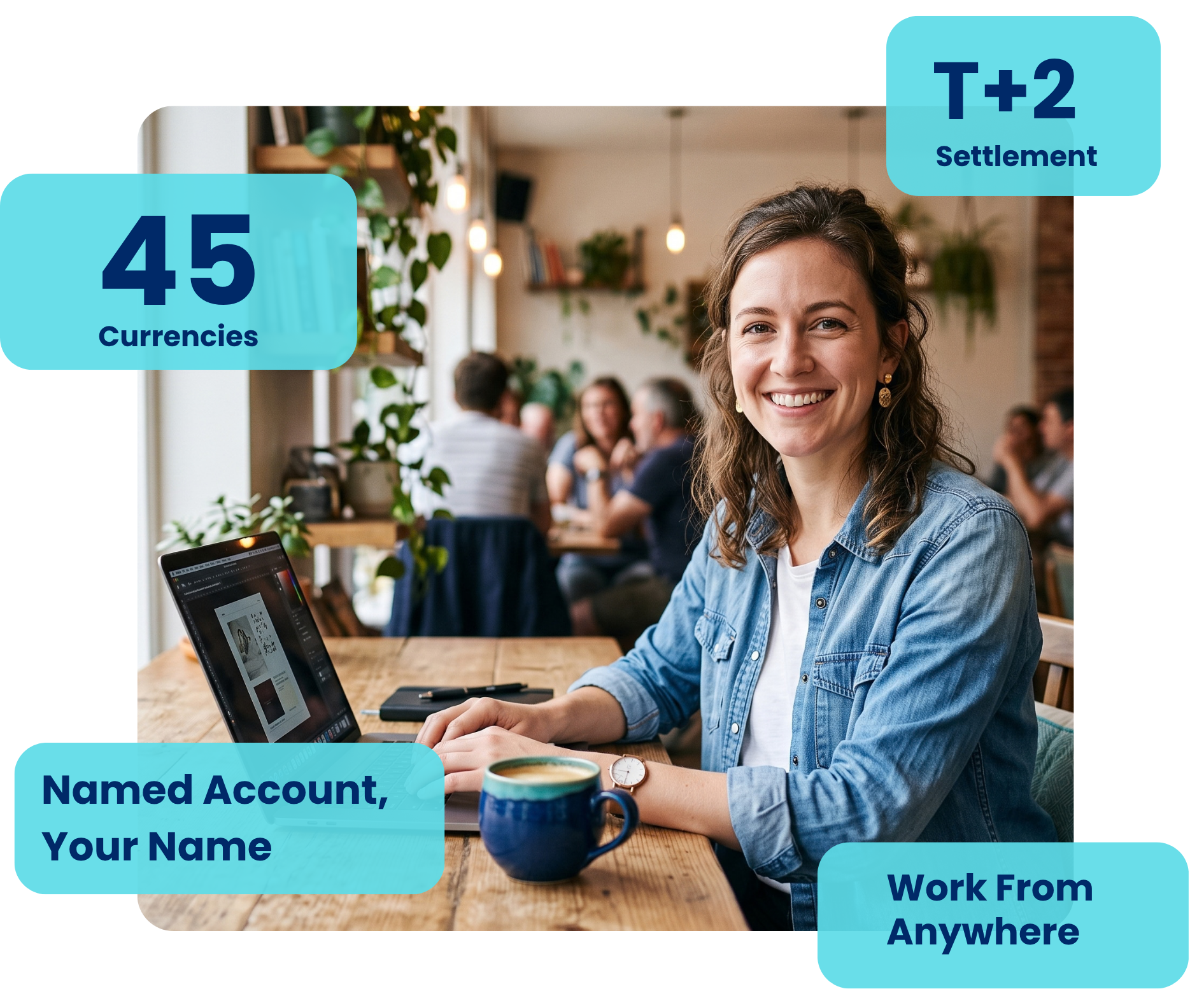
Whether you're a sole trader invoicing from a home office or a digital nomad working from three countries this quarter, DSGPay gives you a named account with no local entity, no minimum balance, and no fixed address required. Get paid locally by clients anywhere DSGPay operates, hold what they send you, and move it on — all from your phone.
What it is

A named account built around a sole trader or digital nomad, not a company you don't have

For sole traders and digital nomads, three things make up the account: where money lands, how you manage it, and how you convert it. All three are yours from day one, whether you're operating from a fixed home base or moving between countries every few months.

Named Virtual Accounts

Local bank-equivalent account details — account number and in-market routing information — issued in your own name. Clients pay in exactly the way they'd pay a local business, because as far as their bank is concerned, that's what they're doing.

DSGPay DMA

The mobile app is where this segment actually lives day to day. Balances, approvals, and transfer history — all built for someone who works from wherever they are, not from a desk on a fixed schedule.

FX on your terms

Convert a balance into your operating currency, or into whatever currency you need to pay someone else, whenever you choose to — not automatically, and not at whatever rate a home bank quietly applies.
Why it matters

For sole traders and digital nomads, it isn't really a payments problem. It's an identity problem.

Banks and most "business accounts" are built for a fixed address and a registered entity. A sole trader working solo, or a digital nomad working across three countries this quarter, has neither — so they get pushed into one of three workarounds, and all three cost them.

1. Asking the client to wire internationally

The client eats an unfamiliar SWIFT process, sees a foreign-sounding beneficiary name, and either delays payment while they double-check it's legitimate, or asks to just send it a different way instead — a way that's worse for you.

2. Routing everything through a personal account back home

Every incoming payment becomes a cross-border wire — correspondent bank fees taken out along the way, a weaker FX rate than you'd get converting on your own terms, and three to five days of float before the money is actually usable.

3. Using a marketplace-style payment link

It solves collection, barely — but does nothing for paying a subcontractor, holding a balance in more than one currency, or looking credible to a corporate client's accounts payable team, who often won't pay a personal link at all.
The real issue
None of these workarounds scale past a handful of clients, and all of them cost money and time on every single transaction. A digital nomad's location changes constantly — but their client base doesn't. What they need is infrastructure that's currency-native to their clients, not geography-native to themselves.
How it works

How a sole trader or digital nomad gets from opening an account to getting paid, in five steps

1. Open an account as an individual, not a company

Onboarding is identity-based. There's no company registration to produce, no board resolution, no proof-of-business-address step that assumes you have a fixed office — because you don't need one. No minimum balance to open, either.

2. Share your local account details with a client

The same way a local business would. The client pays as a domestic transfer, in their own currency — no SWIFT fee on their end, no unfamiliar foreign beneficiary name triggering a second look, and settlement that's faster than a cross-border wire.
Named Virtual Accounts

3. Watch it land, and manage it from your phone

Balances update in real time as client payments arrive. Approve an outgoing transfer — paying yourself out, paying a subcontractor, paying a supplier — with a tap, from whatever time zone you happen to be working in that week.
DSGPay DMA

4. Hold multiple currencies side by side

A THB balance from a Bangkok client and a KRW balance from a Seoul client don't get force-converted the moment they land. They sit as their own balances until you decide what to do with them.

5. Convert when it suits you

Move a balance into your operating currency, or into whatever you need to pay someone else in, at the point you choose to act — not on a schedule set by someone else's system.
FX
In practice

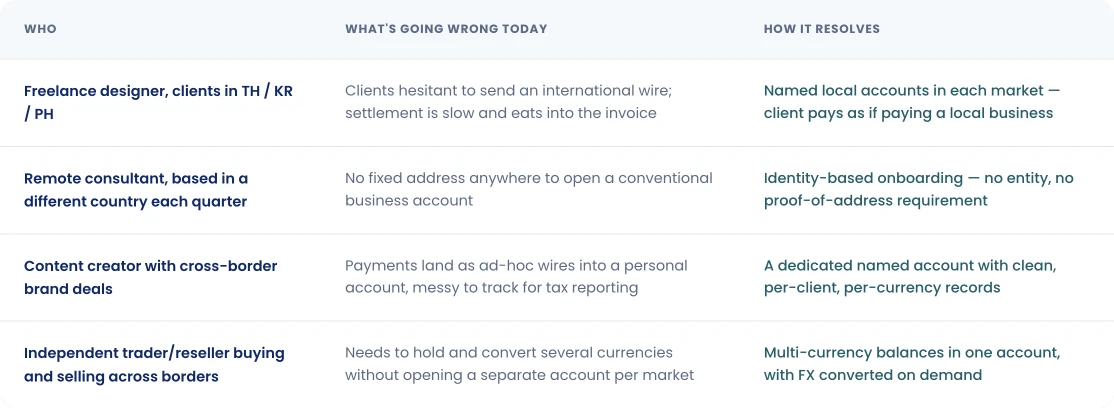
The same account, four different ways of working

Different reasons to need this, same underlying fix in each case.
0
Local entity or company registration required to open an account
0
Minimum balance to get started
1
App to get paid, hold, and convert across every currency you invoice in

Outgrowing a one-person setup?

If you incorporate or start bringing on contractors, the same account infrastructure carries forward into DSGPay's SME tier — bulk payouts, role-based access, reconciliation tooling — without migrating accounts or losing your transaction history.